Digital Twin Water Management: A Solution for Responding to Climate Risks
As climate change makes extreme rainfall and drought increasingly commonplace, water management is shifting from “post-event response” to “prediction-based risk management.”
The government and K-water are strengthening summer flood countermeasures and advancing on-site response systems while taking proactive action through digital twin technology and AI- and data-driven smart water management.
Text by. Editorial Team Photos by. K-water
Strengthening “Intelligent Response” for Summertime Flood Control Measures
Weather patterns in Korea have clearly changed in recent years. The rainy season has become shorter, yet enormous amounts of precipitation are concentrated within limited areas when rain falls. Last year, record-breaking downpours exceeding 100 mm per hour occurred in areas such as Seosan, Sancheong, and Gapyeong despite lower-than-average total rainfall during the monsoon season. As “extreme rainfall”—wherein large volumes of rain fall within a short period—becomes the norm, the government has moved to strengthen summer flood response measures.
The Ministry of Climate, Energy, and Environment announced the “2026 Summer Flood Countermeasures” centered on securing “hidden water storage capacity” and implementing intelligent response systems based on artificial intelligence (AI) and digital twin technologies. By using agricultural reservoirs, hydropower dams, estuary barrages, and other facilities, the government plans to secure an additional 1.04 billion m³ of flood control capacity—equivalent to about three times the flood-control capacity of Hantangang Dam—bringing the total available water storage capacity to 11.86 billion m³. AI-based flood forecasting and urban inundation forecasting systems will also be used to predict risks. Flood advisory and warning systems will be introduced in flood-prone areas such as Gangnam Station, with emergency disaster text messaging systems to be strengthened in high-risk flood zones to minimize damage.
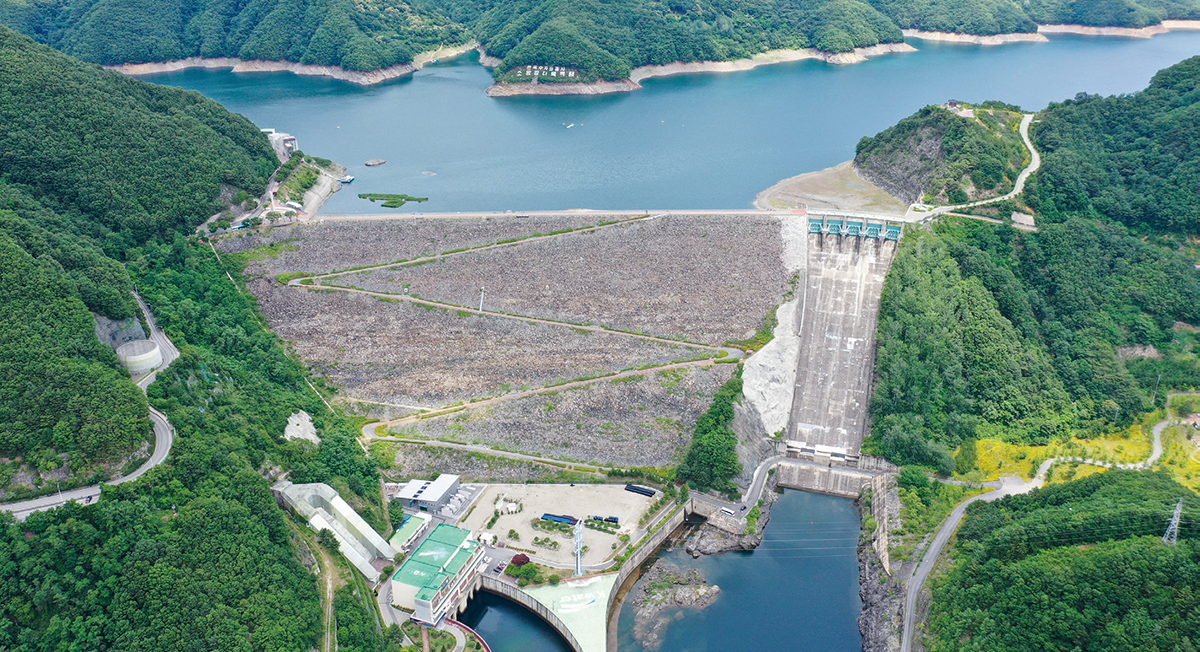
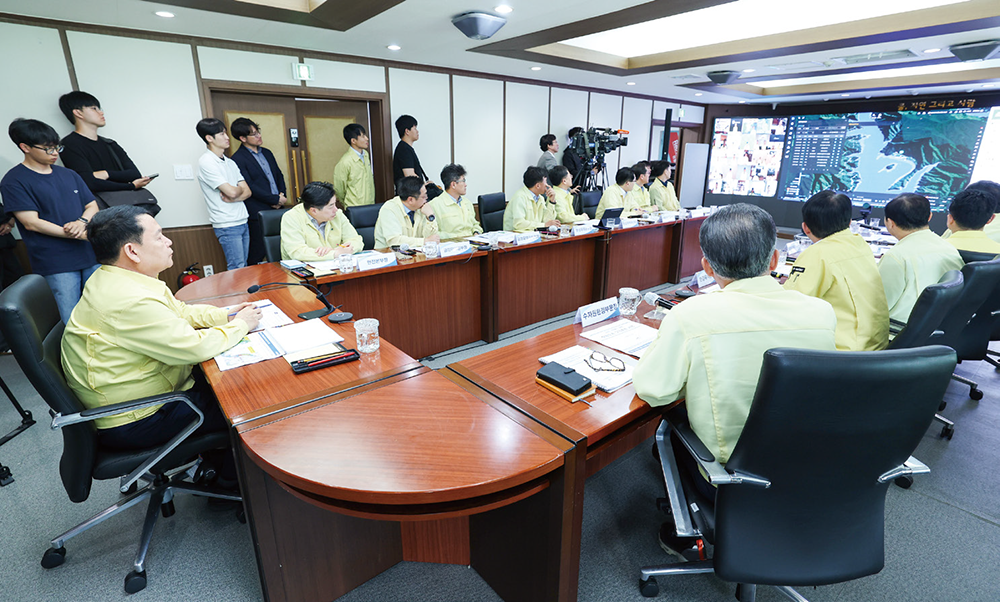
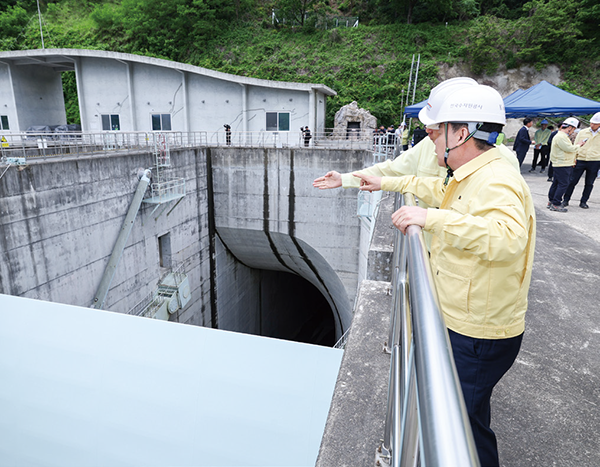
In response, K-water conducted a special flood-season countermeasure meeting and a practical joint emergency drill at Soyanggang Dam in Chuncheon, Gangwon-do on May 28, comprehensively inspecting its extreme-flood response system. In accordance with the government’s flood response policy, K-water plans to lower water levels at 20 multipurpose dams to more than half of their total storage capacity by June 20 before the start of the flood season, securing a total of 6.8 billion m³ of flood control storage space in advance. This volume is more than three times the dams’ designed flood control capacity of 2.18 billion m³ and is enough to fill Lotte World Tower approximately 4,500 times. K-water has also fully transitioned to a company-wide operational flood response system by intensively inspecting AI-based weather forecasting systems, application status of digital twin technology, emergency response procedures, downstream resident notification systems, pre-flood-season storage capacity status, dam operation plans during the flood season, and operational condition of gates and discharge facilities.
Digital Twin Water Management Technology Connecting Prediction, Simulation, and Decision Making
The key enabler of such proactive responses is digital twin-based water management technology. A digital twin is a next-generation water management technology that recreates actual water resource environments in a digital virtual space, enabling real-time integration, analysis, and forecasting of all water management elements within a watershed including rainfall, river water levels, and dam operations.
K-water’s digital twin-based water management platform “Digital GARAM+” supports more effective decision making by monitoring water-related data and meteorological information in real time and providing scenario-based analysis results, enabling safer and more efficient water management.
Its ability to analyze up to 48 discharge scenarios simultaneously under varying rainfall conditions and identify optimal dam operation strategies demonstrates a shift from simple status monitoring to a water management system capable of predicting future risks. The platform is currently being applied to and operated at 56 dams and weirs nationwide. It has also enhanced monitoring and flood analysis capabilities through the integration of drone-based high-precision 3D terrain modeling, high-resolution object information production, and AI CCTV-based detection of flooding, pedestrians, and vehicles. In fact, through Digital GARAM+, K-water successfully responded to the heavy rainfall that struck the Chungcheong and southern regions in July of last year by retaining all of the inflowing water without releasing water through dam gates, ensuring stable flood management.
K-water’s Water Management Technology Emerging as a Solution to Global Climate Risks
Risks related to water disasters and water security continue to grow as climate change intensifies worldwide, driving increasing interest in digitally based water management solutions. According to market research forecasts, the global smart water management market is expected to grow at an annual growth rate of 12.5% from USD 19.01 billion in 2024 to USD 61.7 billion by 2034.
Given this trend, K-water’s digital twin water management technology is gaining recognition as a next-generation solution not only in Korea but also overseas. K-water participated in the development of a digital twin pilot platform for urban flood response in Jeddah, Saudi Arabia, completing terrain data construction as well as the development of monitoring and simulation visualization functions. Through follow-up projects, K-water is seeking to expand its operations throughout Jeddah and to other cities such as Mecca and Medina. K-water is also implementing a phased project in Nagai City, Yamagata Prefecture, Japan to establish a digital twin- and drone-based disaster-response water management system, while discussions continue regarding expansion to other local governments in Japan. In the United States, K-water signed a memorandum of understanding with Valley Water—which manages water resources in the Silicon Valley region—to establish an integrated digital twin water management system; it is promoting the development of a watershed-scale platform encompassing dams, water treatment plants, and pipelines.
Digital twin water management technology is therefore expected to become a key sector driving not only infrastructure operations but also the industrialization and value enhancement of water management technologies. Whereas the water industry was once primarily a construction-focused sector centered on building dams and pipelines, it is now evolving into a digital water management industry driven by data analysis and future forecasting. As global demand continues to expand—from securing stable water resources in the Middle East to climate disaster response in Asia and to the digital transformation of aging infrastructure in advanced water management nations—K-water’s Water Management Technology is expected to emerge as both a solution for strengthening climate-risk response capabilities and a new national growth engine leading exports of data-driven water management solutions.

 View previous
 이전호 보기