When spring arrives, the Seomjin River becomes a sheet of silk, and the flower-lined road that follows its current turns into a passageway to the sky. Hadong’s “Ten-ri Cherry Blossom Road,” which stretches from Hwagae Market to Ssanggyesa Temple, has broadened its horizons to become a place where the vitality of spring and human culture coexist.
Text & Photos by. Woonsuk Lim, travel writer
Hwagae Market, Formed Along the Seomjin River
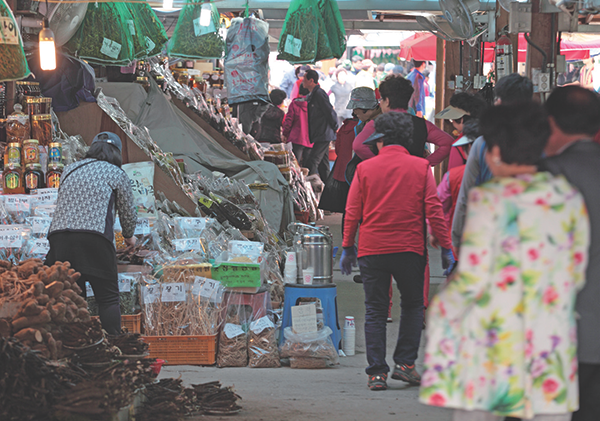
The journey begins at Hwagae Market, an unmissable highlight of any trip to Hadong. As the famous song “Hwagae Market” goes, “Along the flow of the Seomjin River that crosses Jeolla-do and Gyeongsang-do…,” a vibrant market unfolds.
In the years before Korea’s liberation, Hwagae Market figured among the largest markets in the Eight Provinces of Joseon. Slash-and-burn farmers from nearby Jirisan Mountain brought bundles of bracken and deodeok (root of a Korean mountain herb), while people from inland regions such as Gurye in Jeollanam-do and Hamyang in Gyeongsangnam-do traded rice, barley, and other grains. Itinerant merchants who roamed the Eight Provinces never missed this place, and coastal residents from Yeosu, Gwangyang, Namhae, Samcheonpo, Chungmu, and Geoje arrived in boats laden with seafood. Though it may appear to be an ordinary rural marketplace, it sold every conceivable necessity and nothing superfluous.
As people from diverse regions gathered there, their dialects and customs blended, laying the foundation of Hadong’s distinctive market culture. Although some people regret that modern-day commercialization has diluted its old-world charm, the dynamism of the marketplace—where countless meetings and farewells have expanded the breadth of life—remains undiminished. In particular, the heavy clang of hammers resonating from the blacksmith’s shop at the market entrance vividly proves that it is not a frozen relic of the past but a living present.
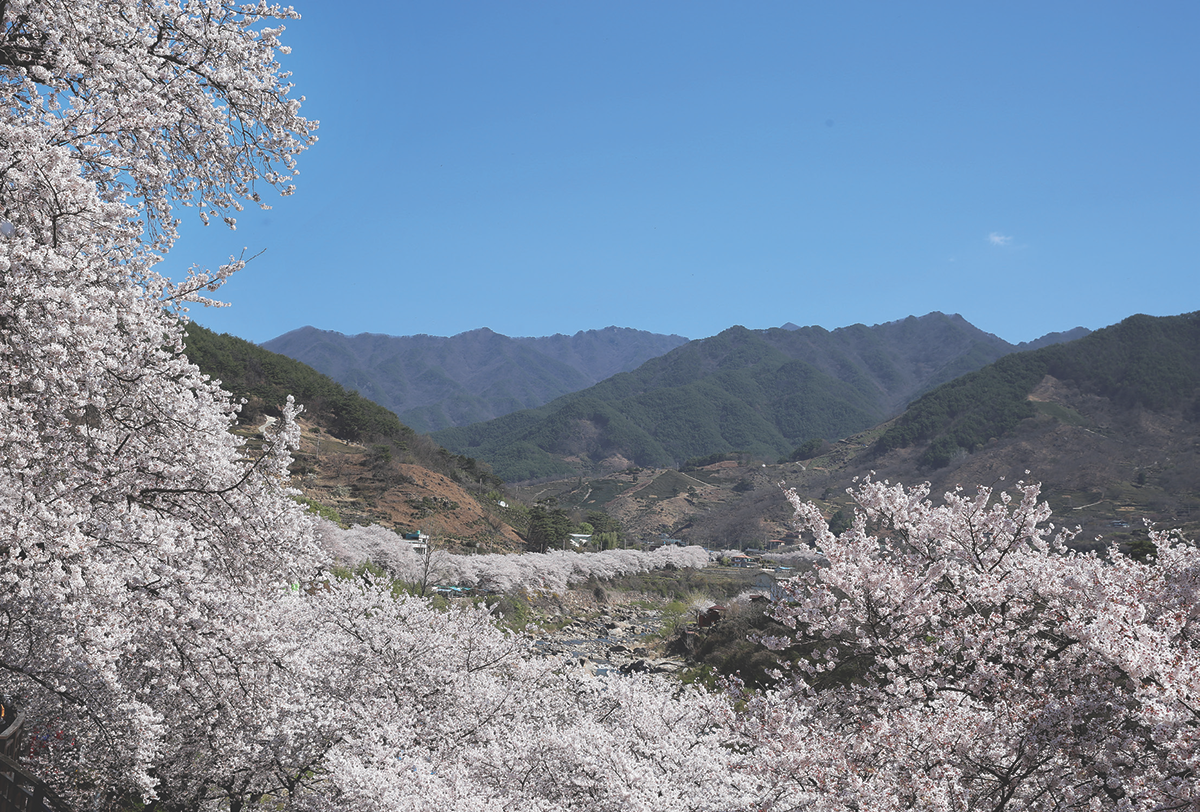
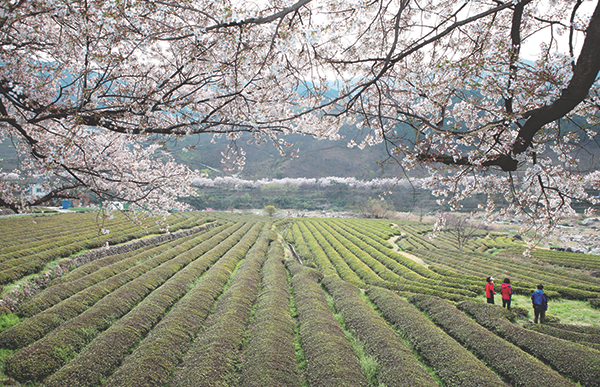
Leaving Hwagae Market behind, the journey continues along Local Road 1023. In early April of each year, a pink corridor of cherry blossoms stretches along the road for about five kilometers, drawing breathless exclamations of admiration. The approximately 1,200 cherry trees lining this road were planted by residents in 1931, when a new road was laid from Hwagae Market to Ssanggyesa Temple. The saplings carefully planted by locals in that harsh era have now grown into a magnificent cherry blossom tunnel that welcomes all travelers every spring.
Hwagae Market
A Tap-ri, Hwagae-myeon, Hadong-gun, Gyeongsangnam-do
T 055-883-5722
Shooting location of the TV drama “Toji,” the House of Choi Champan
A 66-7 Pyeongsa-ri-gil, Agyang-myeon, Hadong-gun, Gyeongsangnam-do
T 055-880-2960
The House of Choi Champan and the Rice Paddies of Pyeongsa-ri
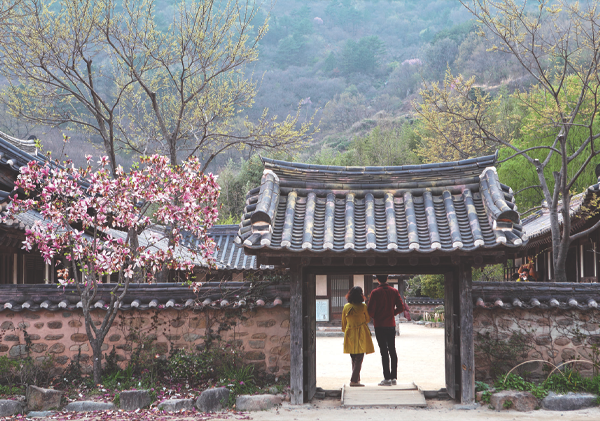
At the midpoint of the five-kilometer-long Cherry Blossom Road lies Pyeongsa-ri, Agyang-myeon, the principal setting of Park Kyung-ni’s epic novel Toji (The Land). Interestingly, the author had no personal ties to this area and drew her inspiration solely from its landscape, most notably the expansive, fertile Pyeongsa-ri plains, the meandering Seomjin River, and Jirisan Mountain, which embrace the village like a folding screen and seem ideally suited for the grand narrative of an epic novel.
Agyang-myeon is a “Slow City” composed of thirty villages. It is said that Su Dingfang, a Tang general who led the allied Silla-Tang forces, named the area after exclaiming that its scenery resembled Yueyang (Agyang) in Hunan, China. True to a village that practices the aesthetics of slowness, it is best experienced not in haste, but at a measured pace.
First, tourists are recommended to visit Dongjeongho Lake via the entrance to the village. Along its tranquil shores, flowers sing of spring, and pale green shoots burst forth from branches that sway gently in the breeze. As you pass the lake and climb toward the House of Choi Champan, perched atop a high hill, your breath naturally grows short. Yet it is worth continuing to the summit. The moment you turn around, the neatly divided fields of Agyang spread out like a vast checkerboard before your eyes. As the warm air awakens the sleeping earth and fresh sprouts herald the beginnings of new life, you readily understand why the author found the narrative thread of her monumental story here.
The path leads into a village where characters from the novel seem ready to step out at any moment. The houses of Gilsang and I-Pyeong and the humble dwellings of tenant farmers bring scenes from the novel vividly to life. The highlight of the journey is undoubtedly the House of Choi Champan. Must-see sights include the raised wooden-floored hall of the sarangchae, which boasts a splendid panoramic view, and the byeoldang annex, which is imbued with the noble sorrow of the protagonist Seo-hee.
Following the Deep Fragrance of the King’s Tea
Between the dense clusters of cherry trees, endless fields of green tea unfold. The neatly trimmed tea bushes resemble rows of green rice cakes. While Boseong inevitably springs to mind when thinking of green tea, Hadong is the true “home of tea” as it is the place where Korea’s oldest wild tea trees grow naturally.
The first records of Korea’s tea culture appear in Samguk Sagi (History of the Three Kingdoms, 1145), which notes that tea was already being enjoyed by the people of Silla during the reign of Queen Seondeok. The Hwagae area of Hadong, in particular, was a representative “Daso,” or tea-producing region, that presented tea to the royal court from the Silla period onward. During the Goryeo dynasty, there was even a government office called the “Dabang,” which was responsible for managing tea for the royal court, and Hadong continued to offer tea to Korea’s monarchs right up until the late Joseon period. As such, the term “the King’s Tea” attests to the distinguished status of Hadong tea.
Hadong tea is also called “Jukrocha” (Bamboo Dew Tea) because it is said to be made from leaves nourished by bamboo dew, as well as “Jakseolcha” (Sparrow’s Tongue Tea), because its small leaves resemble a sparrow’s tongue. It is a masterpiece of nature shaped by the pristine natural environment. At the Hadong Wild Tea Museum (Tea Culture Center) near the entrance to Ssanggyesa Temple, visitors can explore the long history and culture of tea at a glance and learn about the calm found in a cup of tea during a traditional tea ceremony experience.
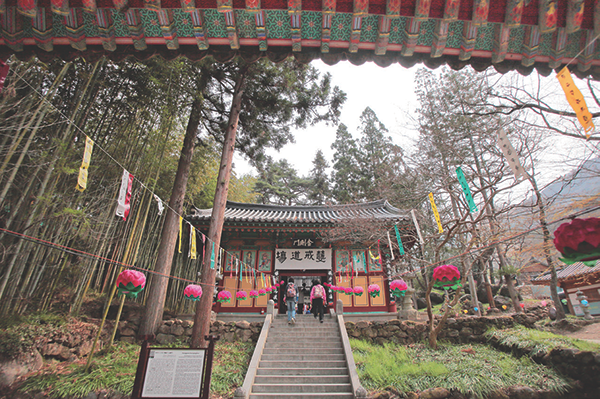
A ten-minute walk from the museum brings one to Ssanggyesa Temple, which has a profound connection with tea. Founded in the twenty-second year of the reign of King Seongdeok of the Silla dynasty (723), Ssanggyesa—meaning “the place where two streams meet”—stands at the boundary where the worldly bustle recedes and spiritual reverence fills the soul. The buoyant excitement of spring settles into a deep and lasting calm the moment one passes through the Iljumun Gate. Within the temple grounds, the Stele of Master Jingam (designated as a National Treasure), which bears an inscription composed by Choe Chi-won to honor the monk’s life and achievements, has endured in perfect silence for a thousand years, while Daeungjeon Hall (the temple’s Main Hall, designated as a Treasure) displays its elegant dignity in the bosom of Jirisan Mountain.
Ssanggyesa Temple
A 59 Ssanggyesa-gil, Hwagae-myeon, Hadong-gun, Gyeongsangnam-do
T 055-883-1901
Hadong Wild Tea Museum
A 571-25 Ssanggyero, Hwagae-myeon, Hadong-gun, Gyeongsangnam-do
T 055-884-2955
Hadong Pine Forest and Haeddeul Ranch: Tranquil Relaxation and Dynamic Interaction
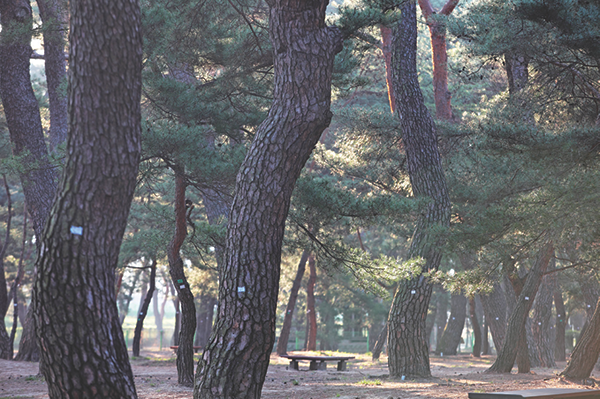
Upon arriving at a bend in the Seomjin River, one comes to Hadong Songnim, a 300-year-old pine forest designated as a Natural Monument. Created in 1745 (the twenty-first year of the reign of King Yeongjo of the Joseon dynasty) to block river breezes and blowing sand, the forest stretches for about two kilometers in a grand display of ancient pines. Stepping inside the forest, one is overwhelmed by the sharp scent of pines. As the fragrance spreads on the river breeze and the water flows quietly before your eyes, you will surely be filled with a sense of timeless peace.
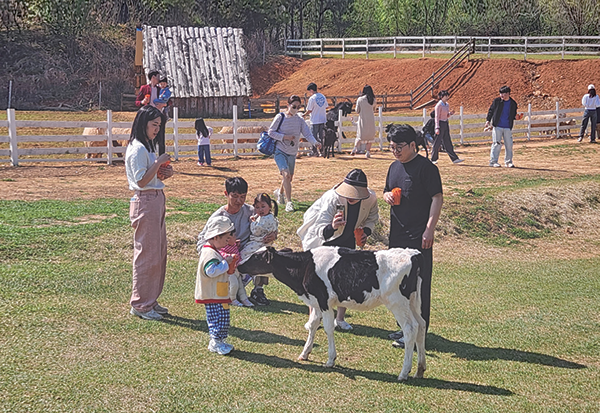
While Hadong Songnim offers tranquil rest, Haeddeul Ranch in Okjong-myeon provides the stimulus to vibrant interaction. On the grasslands unfolding against the backdrop of Mt. Oksan of Mount Jirisan, sheep, goats, and dairy cows roam freely, evoking the exotic charm of a European mountain village. After admiring the scenery, visitors can enjoy hands-on dairy experiences such as feeding calves milk and making pizza, which makes it especially popular among families. A picnic on the lawn with freshly made yogurt and bread is the highlight of a visit to Haeddeul Ranch.
Growth is often mistaken as a matter of speed. Yet this journey to Hadong reveals that growth lies in depth. Just as tender tea leaves, after enduring the trials of time, become tea with a profound aroma, so too may our lives, like Hadong in spring, mature slowly—but deeply.
Haeddeul Ranch
A 31-108 Yanggu 1-gil, Okjong-myeon, Hadong-gun, Gyeongsangnam-do

 View previous
 이전호 보기