
 View previous
 이전호 보기
 -
01Achieving Grade 1 in the 2025 Comprehensive Integrity Assessment of Public Institutions
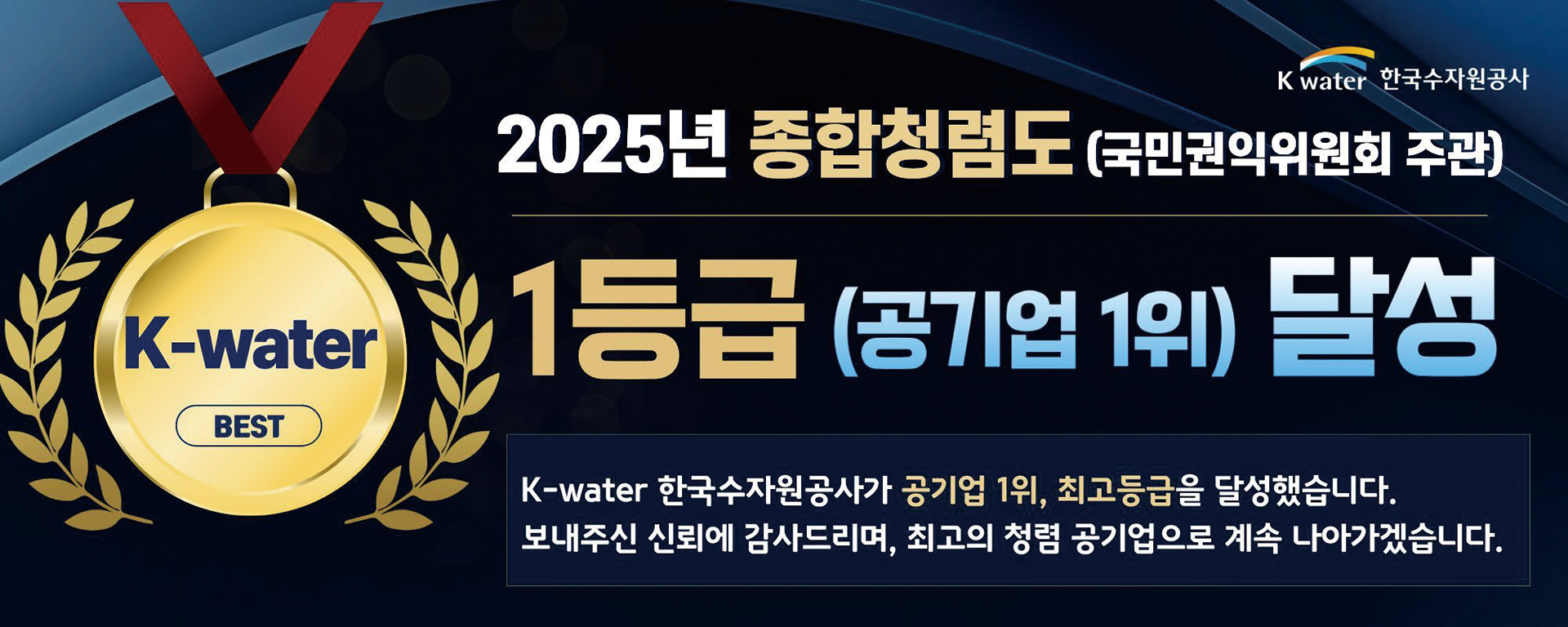
On December 23, K-water achieved the highest possible rating—Grade 1—in the 2025 Comprehensive Integrity Assessment of Public Institutions conducted by the Anti-Corruption and Civil Rights Commission (ACRC). In particular, K-water ranked first in the Integrity Perception category, the only one among 31 public enterprises to do so.
K-water received the top grade in integrity perception, which is directly evaluated by the public and employees, earning recognition for tangible, field-level improvements in integrity. Behind this achievement was an ethical management philosophy led by the head of the organization, supported by a robust internal control system. Centered on the Integrity Internal Control Committee, which includes top executives, K-water objectively reviewed corruption-vulnerable areas and implemented specific and effective improvement measures.
Above all, K-water was selected as an exemplary case in the category of “the leadership’s level of commitment and engagement,” reflecting strong management-led commitment to action. Notably, in the personnel sector, the head of the organization personally acted as a “fair personnel mediator,” overseeing changes to the special promotion system to enhance fairness and transparency in promotion decisions. In addition, K-water operated the Integrity Innovation Drive Task Force to actively identify improvement tasks. Along with running Bespoke, a customized organizational culture coaching program, K-water strengthened its financial real-time monitoring system and implemented Do’s & Don’ts Guidelines to eradicate workplace abuse, leading efforts to eliminate corruption-inducing factors at the field level. These organization-wide efforts culminated in a significant improvement in integrity ratings. -
02The ‘Vision Declaration Ceremony Held to Expand Water Thermal Energy’ at the Trade Center
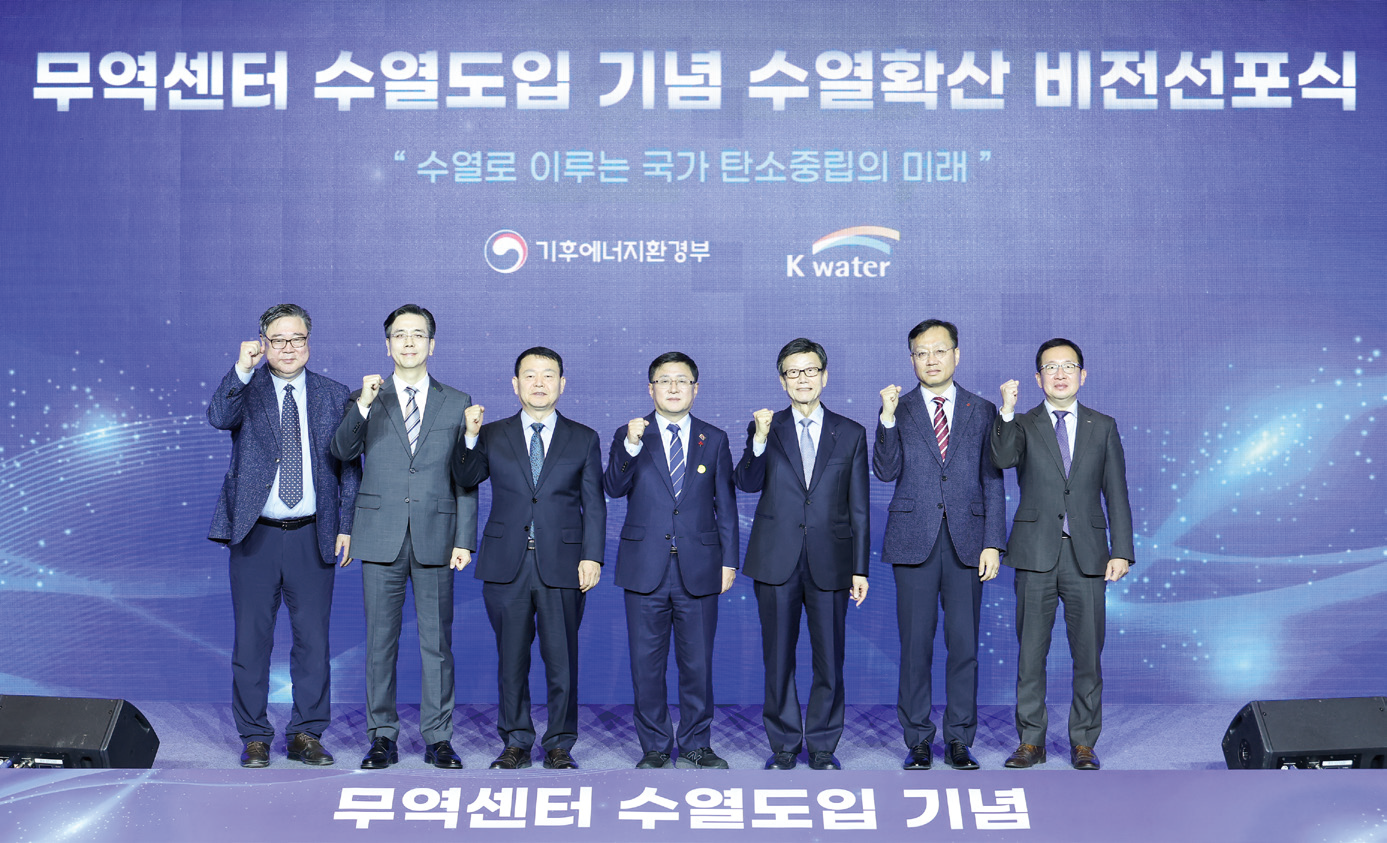
On December 19, the Ministry of Climate, Energy and Environment and K-water held the Vision Declaration Ceremony for Expanding Water Thermal Energy, commemorating the introduction of water thermal energy at the Korea Trade Center in Gangnam, Seoul. This project represents the largest single-building application of water thermal energy in Korea, and is expected to supply cooling energy to COEX, Trade Tower, and ASEM Tower—effectively replacing approximately 7,000 air conditioners.
The newly introduced water thermal energy system has a total capacity of 7,000 RT (refrigeration tons). It utilizes the temperature characteristics of water for heating and cooling, i.e., relatively cool in summer and warm in winter. As it uses existing water supply pipelines as the heat source, no additional power infrastructure is required, making it highly adaptable for rapid deployment even in urban areas.
Building on this project, the Ministry of Climate, Energy and Environment and K-water plan to expand the scope of water thermal energy applications. They are promoting its adoption in large-scale public and mixed-use buildings such as Hyundai GBC, the Yeongdong-daero GTX Integrated Transfer Center, and the Sejong National Assembly Building, while also reviewing the concept of a “water thermal energy highway” that connects buildings via water conveyance pipelines.
Water thermal energy is drawing attention as an urban renewable energy source capable of replacing fossil fuel–based heating and cooling systems. Since it can be applied to existing buildings, it offers greenhouse gas reduction effects without requiring large-scale reconstruction or expansion of power facilities. -
03Launch of the Water Digital Technology Experience Portal ‘waterAX’
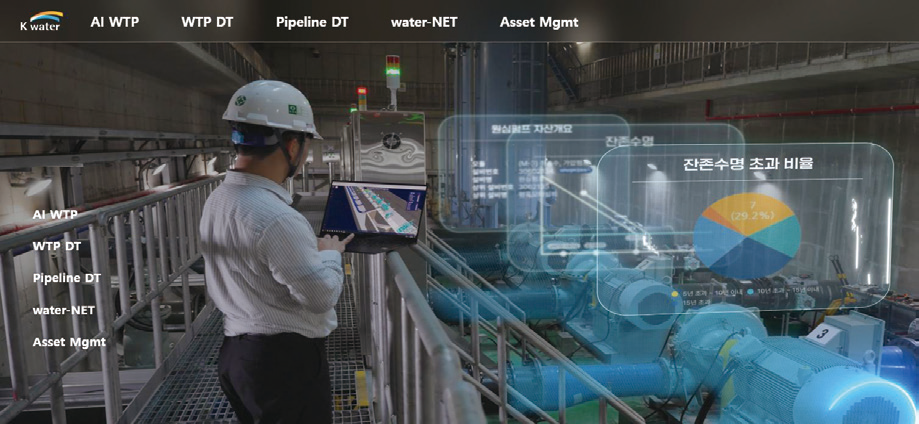
On December 15, K-water newly developed and launched waterAX (http://waterax.wateround.kr), an online portal where users can have hands-on experience with digital water supply technologies.
Until now, digital water technologies developed by K-water—such as AI water treatment plants, digital twins of water treatment plants and pipelines, water-NET, and asset management systems—could only be demonstrated through on-site visits, limiting public accessibility.
The launch of waterAX removes these constraints, enabling users to experience the technologies regardless of time or location. Visitors to the platform can explore K-water’s core water technologies online in formats closely mirroring actual operating environments.
Through this, a wide range of stakeholders—including water utilities, public institutions, and private companies—can intuitively assess the key functions and economic feasibility of each technology, making it significantly easier to make decisions on technology adoption at the initial project planning stage. -
04Establishing a Cooperation Framework with the Korea Environment Corporation for Joint Overseas Water Market Entry
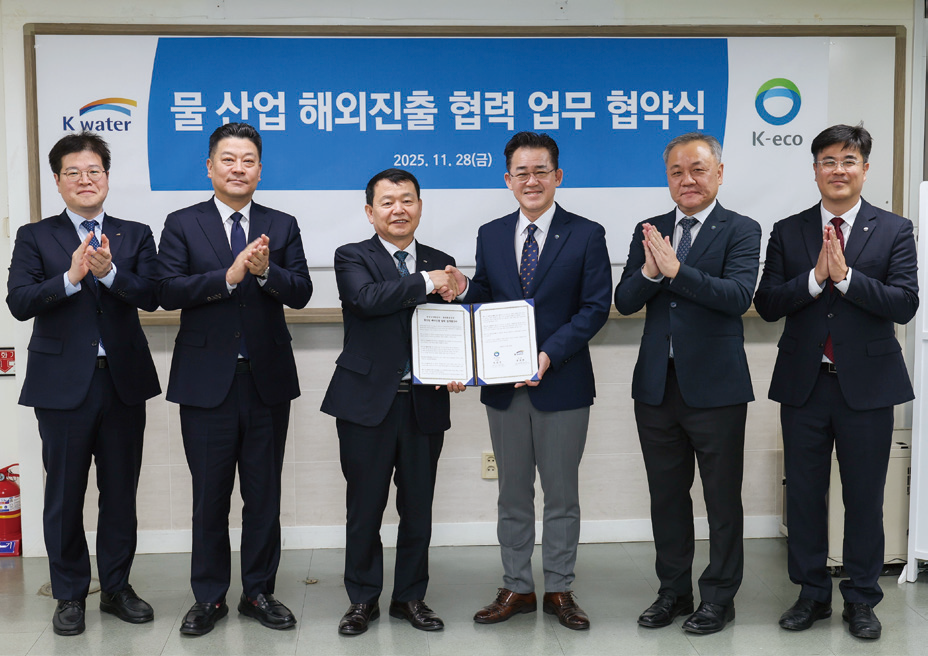
On November 28, K-water signed a Memorandum of Understanding on Cooperation to Support Overseas Expansion of the Water Industry with the Korea Environment Corporation at the Korea Environment Corporation Training Institute, initiating joint efforts to enter overseas water markets.
This agreement aims to establish a foundation for comprehensively responding to the diverse demands of global clients by combining K-water’s accumulated capabilities in identifying, planning, and operating water management projects overseas with the Korea Environment Corporation’s expertise in wastewater and environmental technologies. It is expected to expand overseas opportunities for domestic water companies and strengthen industrial competitiveness.
The agreement covers joint advancement in overseas water industry sectors, the establishment of a cooperation framework to support domestic companies’ global expansion, and technical and human exchanges to promote environmental industry development and international expansion. Through this partnership, the two organizations plan to build an integrated response system covering both water supply and wastewater, jointly pioneer new overseas water markets, and actively support the co-expansion of domestic water companies—thereby further enhancing the global standing of Korea’s water industry. -
05Cooperation with the Ministry of Climate, Energy and Environment and Busan Metropolitan City on AI-Based Water Supply Operation Technologies
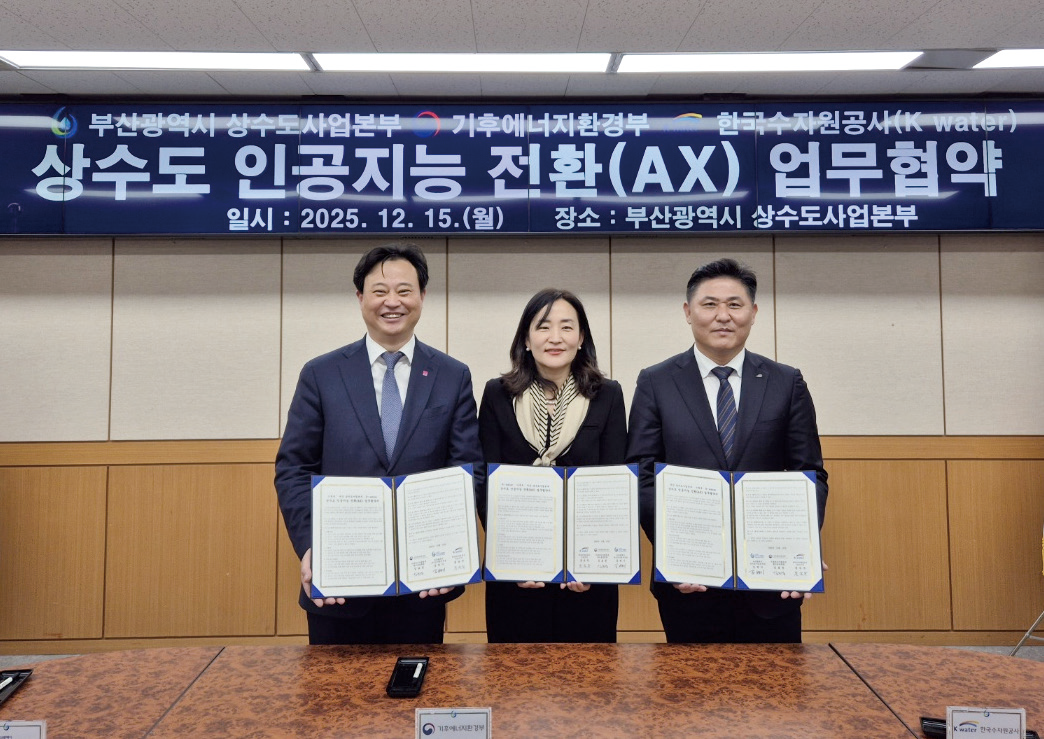
On December 15, K-water signed a Tripartite Memorandum of Understanding for the Transition to Water AX with the Ministry of Climate, Energy and Environment and the Busan Metropolitan City Waterworks Authority. This agreement is significant as the first tripartite collaboration among the central government, a public institution, and a local government aimed at accelerating digital transformation in the water supply sector and expanding AI-based water supply operation technologies nationwide, in alignment with the government’s national AI innovation strategy.
Under the agreement, the Ministry of Climate, Energy and Environment will provide government-level support by establishing policies and systems for AI-based water management and facilitating technology dissemination. K-water will share its AI-based water supply operation experience and technological capabilities—including AI water treatment plant operation technologies deployed at 43 regional water treatment plants nationwide and Smart Water Network Management (SWNM)—with Busan. Together with the Ministry, K-water will promote on-site demonstrations and expansion of AI water management models tailored to local governments. In addition, the parties plan to jointly develop region-specific AI models that reflect the actual operating environments, water quality, and demand characteristics of Busan’s water treatment plants, and to cooperate in developing models that can be gradually expanded to the water supply systems of other local governments. -
06Unveiling the ‘Top 20 Future Water Technologies’ for the Next 10 Years
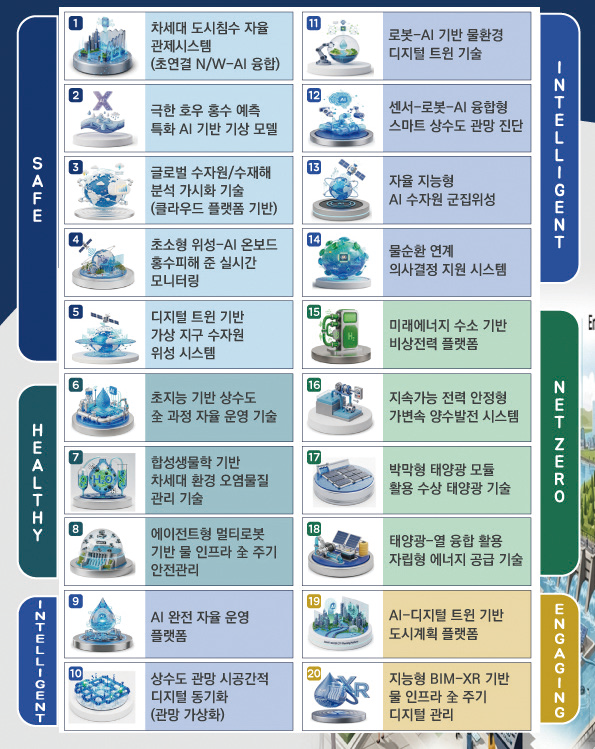
On December 8, K-water selected and announced the Top 20 Future Water Technologies in preparation for the next decade, during which climate and technological changes are expected to accelerate.
The selected technologies were structured around the vision of advancing the SHINE vision—a bright future in which all citizens enjoy the benefits of safe and clean water through innovation in water technologies. They are organized into five core values: Safe Water, Healthy Water, Smart Water, Eco-friendly Water, and Inclusive Water.
The Safe Water category includes technologies designed to predict and respond more quickly and accurately to disasters such as floods and droughts. The Healthy Water category focuses on technologies that more effectively treat emerging contaminants that are difficult to decompose, such as per- and polyfluoroalkyl substances (PFAS). The Smart Water category comprises intelligent management technologies in which water infrastructure autonomously monitors and operates using AI, robots, and sensors. The Eco-friendly Water category supports the transition to carbon neutrality through water-based renewable energy technologies such as floating solar power and hydrogen-based electricity. The Inclusive Water category includes water management technologies that expand public participation, such as digital twin–based urban and watershed planning.